I am a PhD candidate in the Department of Geography at UC Santa Barbara, in the Caylor (WAVEs) Lab and Vegetation Dynamics (GROVE)Lab, co-advised by Kelly Caylor and Anna Trugman. My dissertation is about how coast live oak (Quercus agrifolia) woodlands survive drought — and, increasingly, about what it takes to measure that honestly at the scale of an individual tree.
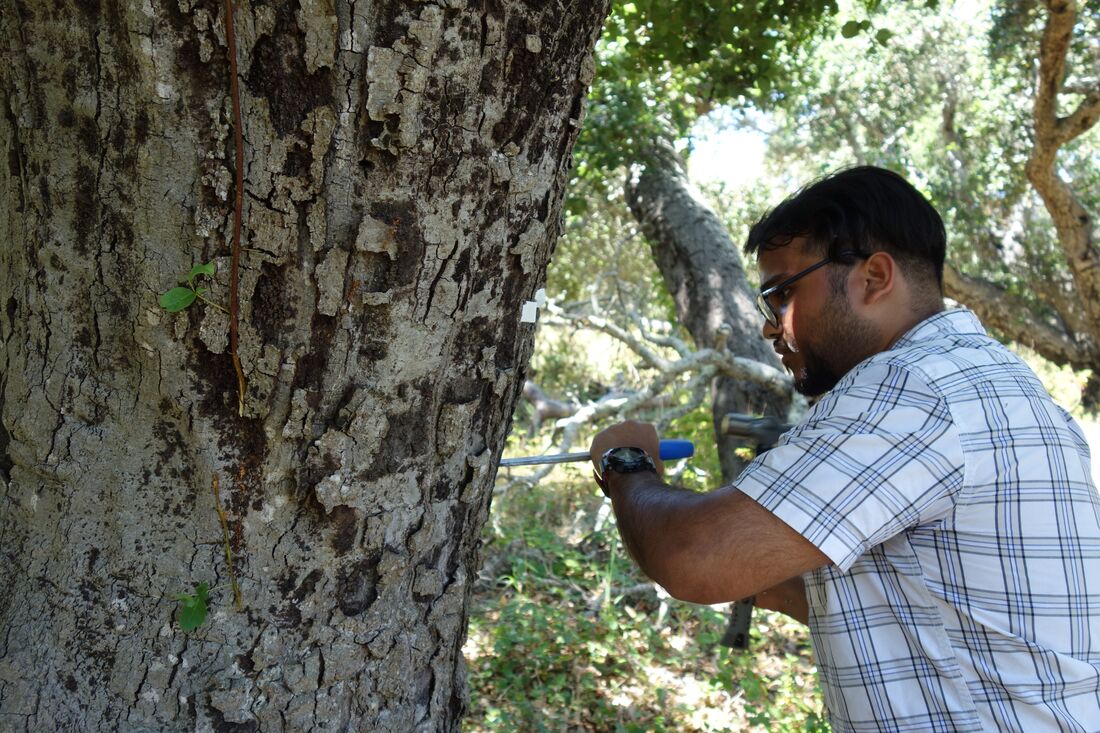
The short version of my research: I instrument a slope transect at the Jack and Laura Dangermond Preserve with sapflow sensors, meteorological stations, soil moisture probes and a LoRa/Starlink telemetry network, fly monthly thermal and multispectral drone surveys over it, take pressure-chamber water potential measurements by hand, and then process the resulting pile of imagery on UCSB’s GRIT cluster using a combination of machine learning, GIS, and signal analysis. The through-line is that I build the instruments before I analyse their output, which makes me the most harshest critique of the measurements I make.
How I got here
I was born in Rajshahi, Bangladesh and raised in Dhaka, where I went to St. Joseph Higher Secondary School and spent an unreasonable amount of time on competitive quizzing and playing Pokemon. I finished secondary school at United World College Changshu in China completing the IB (International Baccalaureate) Diploma, then studied Evolutionary Biology and Environmental Studies at Colby College in Maine as a Davis United World College Scholar, graduating in 2023 with departmental honours and a concentration in biodiversity and conservation.
Colby is where I realized I like spending time around circuits and computers. I spent a year in the Forest Ecosystems Lab applying terrestrial laser scanning to invasive Norway maple in Maine forests for my honours thesis, and wrote the lab’s TLS field protocol along the way. Before that there were green frogs and their skin microbiomes on the Allen Islands, and a semester in Copenhagen chasing urban bats around the Round Tower with ultrasonic sensors. A somewhat scattered CV, in retrospect, but every one of those projects was really about the same thing: getting a sensor to tell you something true about a living system.
What I actually do all day
Roughly a third fieldwork, a third electronics, a third computation, and a standing reserve of time for whichever of the three has broken.
- PositionPhD Student, Geography, UC Santa Barbara (2023–present)
- AdvisorsKelly Caylor and Anna Trugman
- RoleGraduate Student Researcher, Dangermond Ecohydrology, Earth Research Institute
- Field siteJack & Laura Dangermond Preserve, Point Conception, CA
- CertificationFAA Part 107 remote pilot
- PreviouslyB.A., Colby College, 2023 — Evolutionary Biology / Environmental Studies
Teaching and mentorship
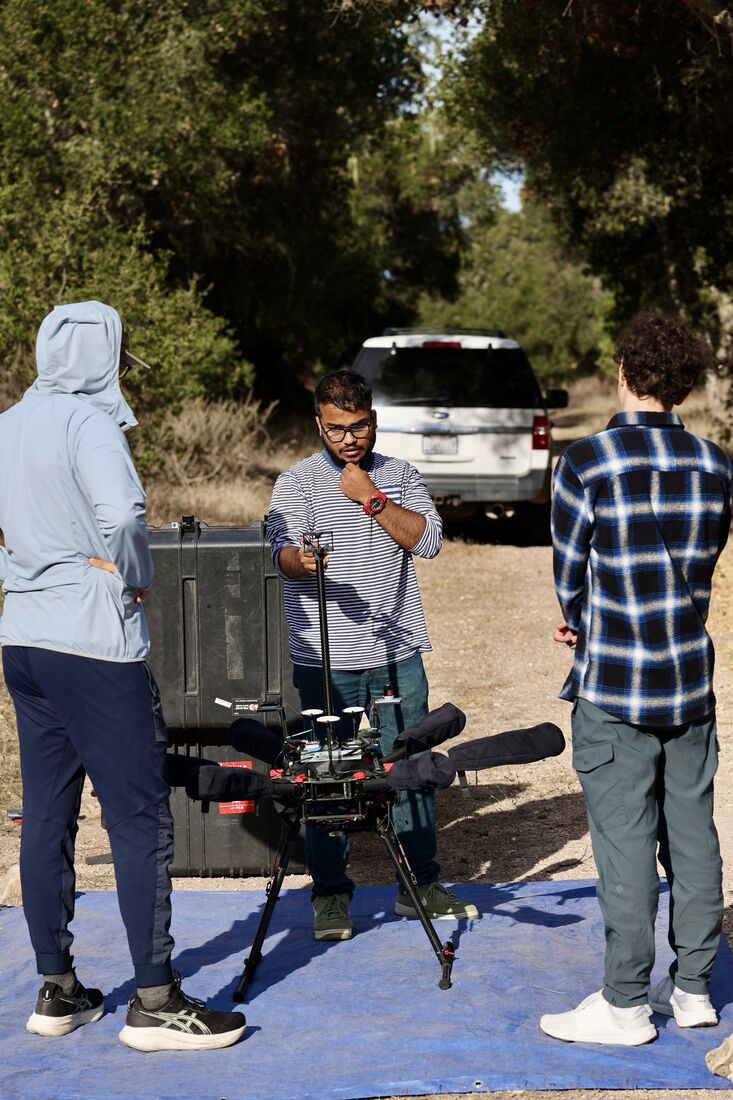
I was the teaching assistant for GEOG 189/289 Close Range Remote Sensing in Fall 2025 under Professor Ian Walker — a heavily field- and lab-based course built around terrestrial laser scanning, UAS and survey-grade GPS, which meant I spent the quarter managing equipment, software workflows and field logistics for both graduate and undergraduate students. I am told it went well.
During the spring break of 2026, I taught GEOG 136 Field Studies in Water, Earth, and Ecosystems under Professor Caylor. It is a 7 day intensive fieldwork course where we camp in the UC Sedgwick Reserve and show students how to use different field equipment like the leaf pressure chamber, ceptometers, soil water potential and moisture sensors, and a dewpoint potentiometer among many other instruments. It involved planning the complete logistics for 13 students, designing their coursework, demonstrating field methods, and advising them on their individual projects. It was my best experience teaching any class, I am always overjoyed at meeting undergrads who have the same passions as me.
Since 2024 I have mentored five or more undergraduates across several departments in fieldwork, electronics, remote sensing and plant physiology, and several have gone on to run their own projects under the umbrella of my dissertation, which is by some distance the most satisfying part of the job. I have also given free application and essay guidance to more than ten high school students in Bangladesh.
Skills, briefly
Remote sensing and GIS — ArcGIS/QGIS, Google Earth Engine, ENVI, RiSCAN, Metashape Pro, terrestrial laser scanning, UAS survey.
Programming and computing — Python, R, JavaScript, HPC/SLURM workflows, AWS/Azure/GCP. I have become the department’s unofficial first line of support for HPC troubleshooting, a role I acquired entirely by accident.
Hardware and embedded systems — Arduino, MicroPython, ZephyrRTOS, KiCAD PCB design, sensor calibration, firmware development, LoRa and Starlink telemetry.
Creative — Adobe Creative Cloud, several DAWs, and a long freelance history in graphic design and audio production that funded most of undergrad.
Awards
Dangermond Travel Grant (2024) · Hollis Prize, Colby College Environmental Studies (2023) · Davis United World College Scholar (2019–2023)
If you would like the long version, there is a CV-shaped page worth of detail I am happy to send on request — or you can just email me.