UCSB.sapflow v1.5.2
Custom sapflow sensor hardware — a Beslity et al. (2022) Js⁵ derivative, built because commercial units cost more than the budget allowed.
Role
Hardware design, firmware, calibration
Tools
KiCAD Arduino MicroPython Sensor calibration
Sapflow sensors measure transpiration directly, by tracking how heat moves through the sapwood of a stem. Commercial units are excellent and priced accordingly — instrumenting a full transect with them was never going to happen on a graduate budget.
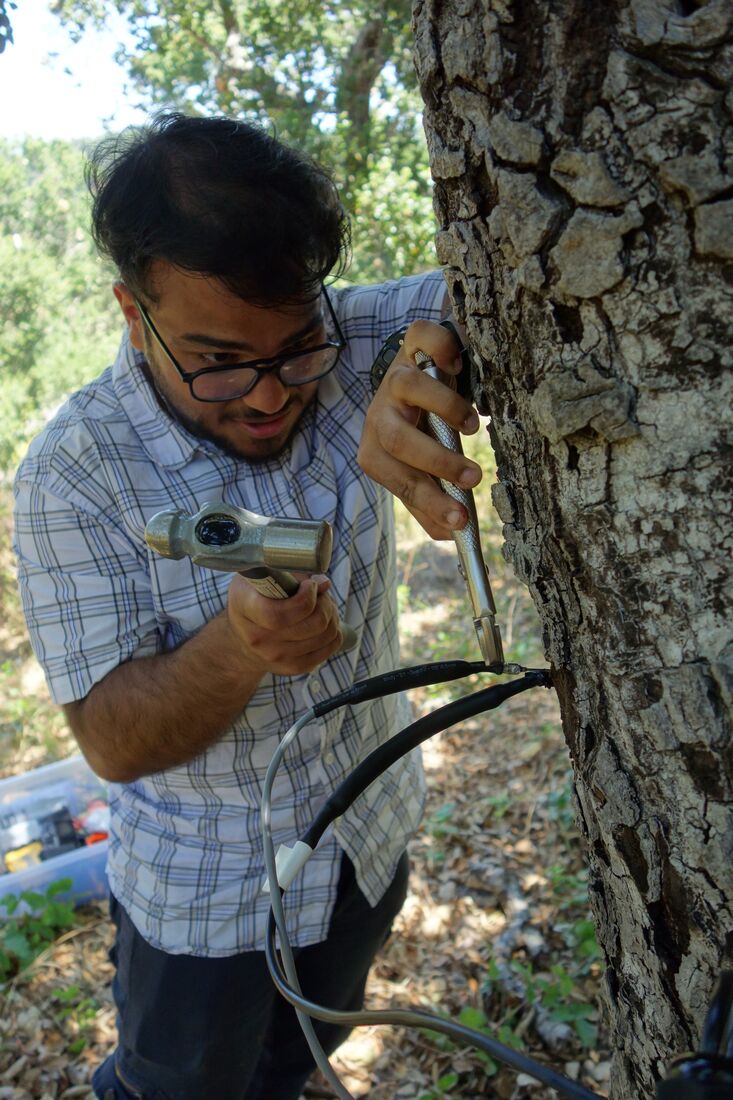
UCSB.sapflow v1.5.2 is our in-house alternative: a derivative of the Beslity et al. (2022) Js⁵ design, adapted for the enclosure, power and telemetry constraints of the Dangermond deployment. The initial sensors were built valiantly by Michael Burnett and his army of undergrads. I took the liberty of continuing the redesign efforts and integrate LoRA, however 98% of the hardwork was done by my undergrad research assistant Jack Driscoll-Natale, a true superstar.
What the work actually involved
Adapting a published design is less about the schematic and more about everything around it: matching the probe geometry to the species, getting a thermal reference that stays stable through a coastal diurnal cycle, and calibrating against pressure chamber measurements taken on the same trees.
Sensors that report plausible numbers and sensors that report correct numbers look identical until you check. Most of the effort here went into testing and separating noise from signal, especially because the HRM (Heat Ratio Method) for calculating sapflux density has very little fluctuations and hence prone to large uncertainties.